About this Discussion

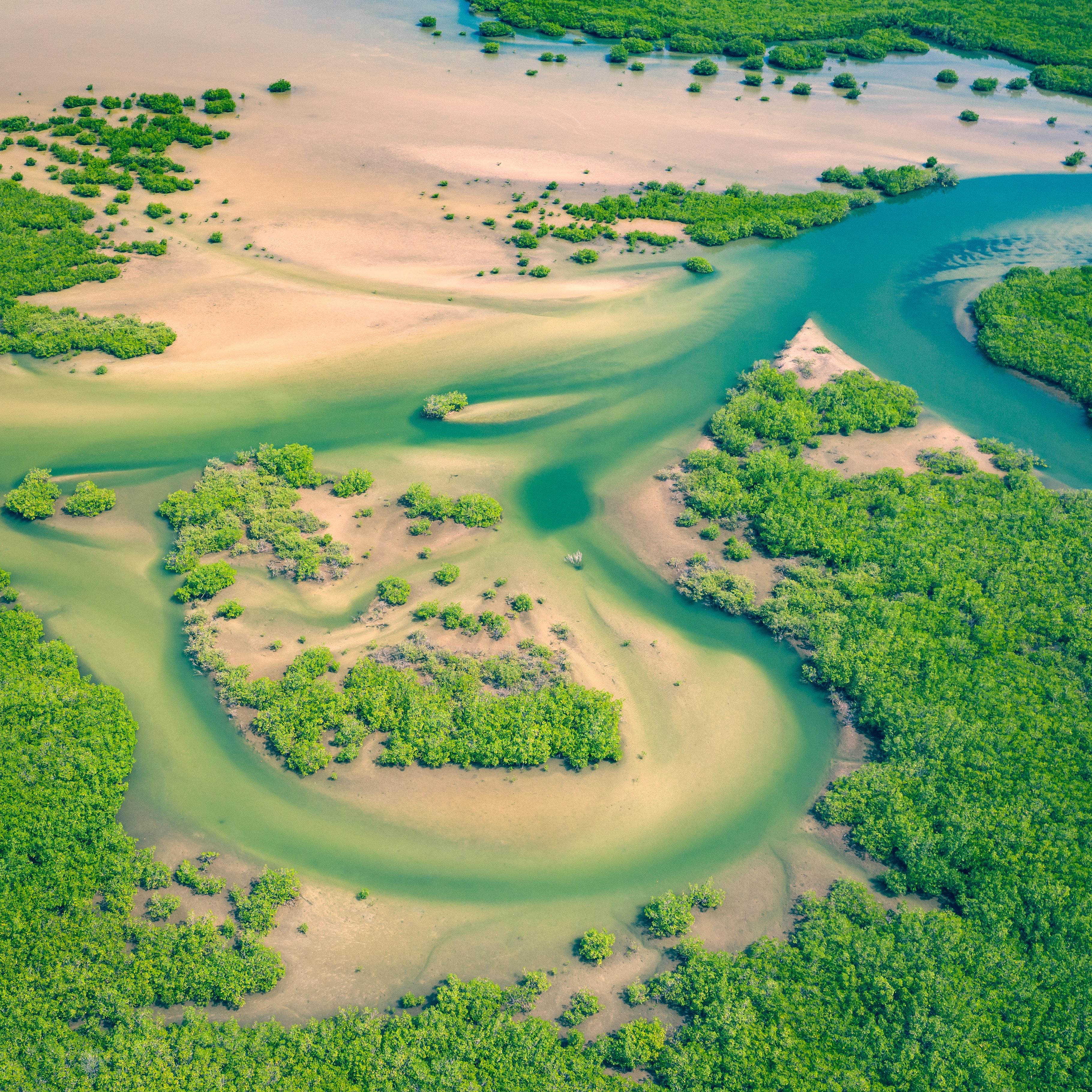
Forests are a source of food, medicine and fuel. In addition to helping to respond to climate change and protect soils and water, they hold more than three-quarters of the world’s terrestrial biodiversity, provide many products and services that contribute to socio-economic development and are particularly important for hundreds of millions of people in rural areas, including many of the world’s poorest.

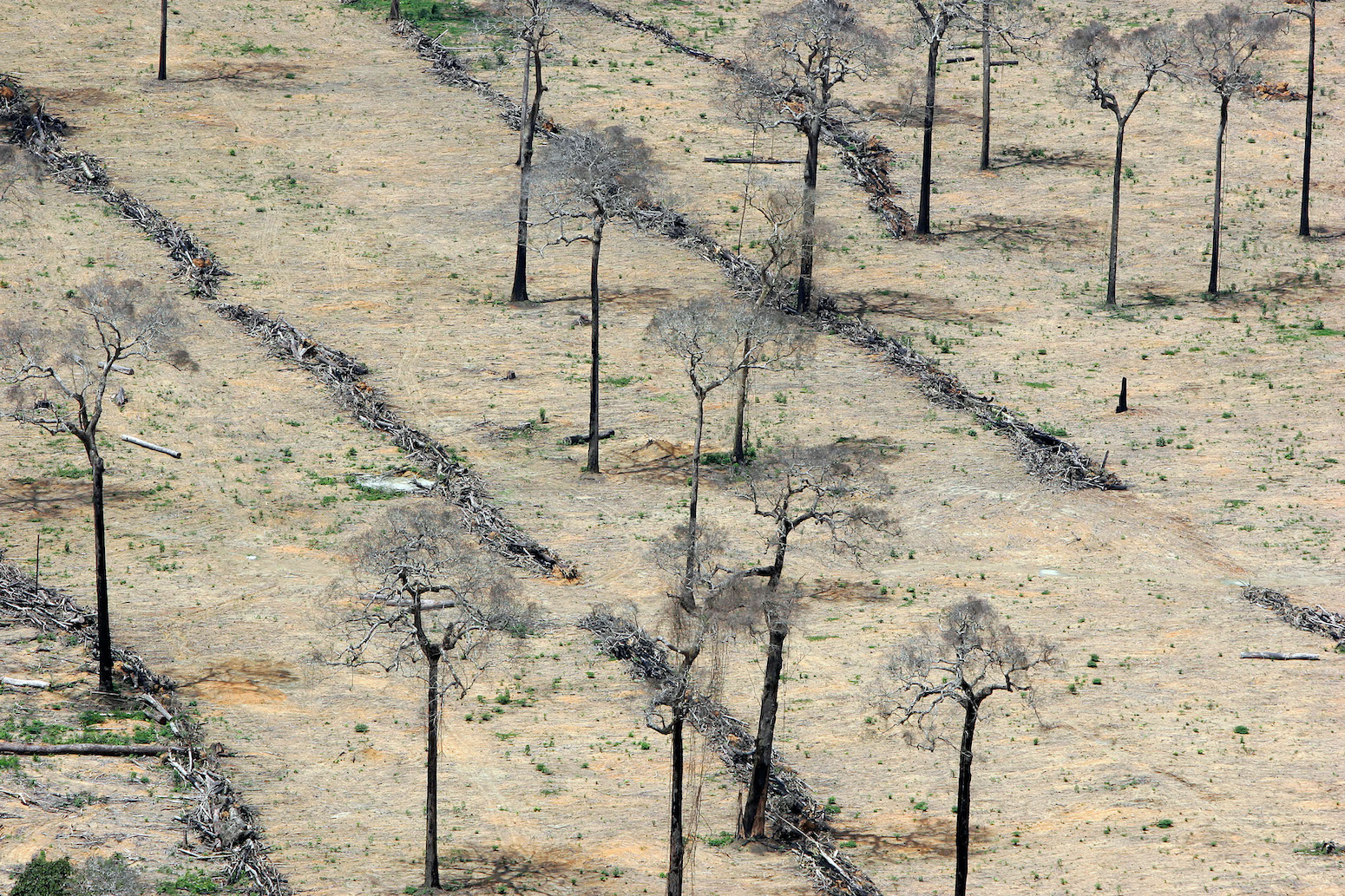
Yet, deforestation and forest degradation continue to take place at alarming rates, which contributes significantly to the ongoing loss of biodiversity. Forests are also particularly vulnerable to climate change impacts such as insect outbreaks, fires, strong winds, droughts, and pathogen attacks.

There are ways, however, to manage the world’s forest ecosystems that will ensure the conservation and sustainable use of their biodiversity. This requires effective governance, integrated policies, land-tenure security, respect for the rights and knowledge of local communities and indigenous peoples, and enhanced capacity for monitoring of biodiversity outcomes. It also requires innovative financing modalities.

Upcoming Events

Forestry

A post is already pinned to this stream. Would you like to replace it?

This week, parties to the UN Convention on Biological Diversity are meeting to develop a new blueprint for nature and people before COP 15 in December.

What will the Post-2020 Global Biodiversity Framework mean for Africa?

Share your thoughts, and join the opening plenary of the Africa Green Economy Conference on 27 June to learn more! ? ggkp.org/AGEC

Read More

https://www.theguardian.com/environment/2022/jun/21/montreal-to-host-delayed-cop15-summit-to-halt-al...

Sustainable Forestry and FAO's Global Forest Resource Assessment...

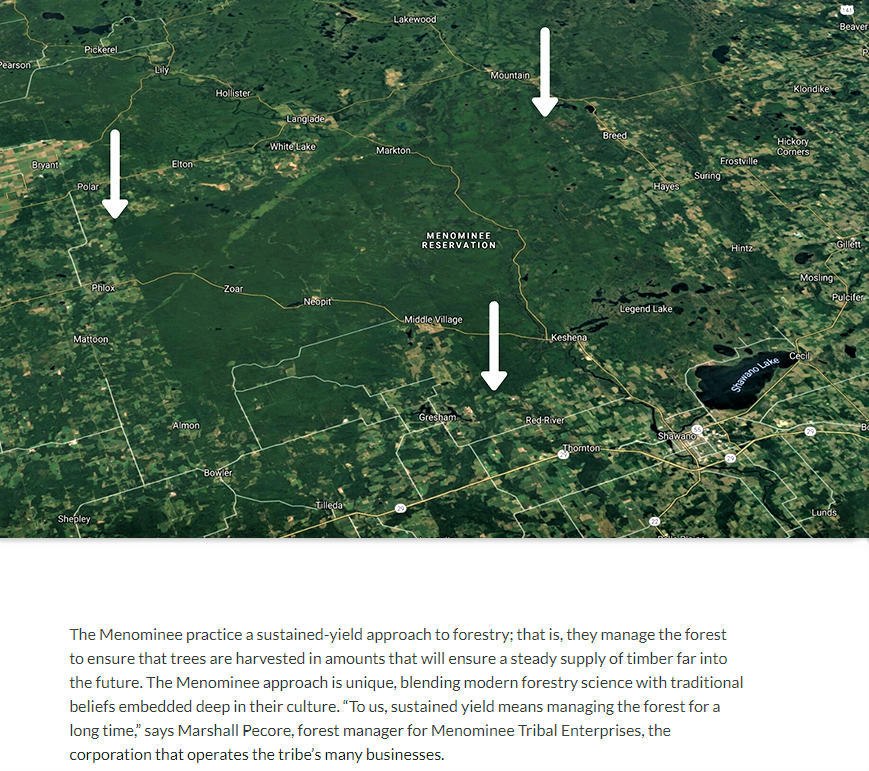
The Menominee Tribe has inhabited Northeast Wisconsin and Michigan's Upper Peninsula for generations, where ancestral tribal lands covered over 10 million acres. Following several treaties and land cessions, in 1854 the Menominee people were confined to their current Reservation lands, totaling 235,000 acres (note graphic).

The Menominee Forest has survived as an island of timber in an ocean of cleared land. It is representative of the Lake States boreal forest that existed prior to clearing for farming by settlers and timber barons (note aerial). The forest has been sustainably managed for more than 150 years and allows the Tribe to experience a traditional quality of life from an intact, diverse, productive, and healthy forest ecosystem on the reservation.

Responsible harvesting has been at the heart and the driving force for forest management on the Menominee Reservation. Currently, there is more standing saw timber volume (1.7 billion board feet) than there was in 1854 (estimated at 1.2 billion board feet). During this same period, over 2.25 billion board feet have been harvested from the same acreage (Menominee Tribal Enterprises, 2020).

FAO has been monitoring the world’s forests at 5 to 10 year intervals since 1946. The Global Forest Resources Assessments (FRA) are now produced every five years in an attempt to provide a consistent approach to describing the world’s forests and how they are changing. The Assessment is based on two primary sources of data: Country Reports prepared by National Correspondents and remote sensing that is conducted by FAO together with national focal points and regional partners. The scope of the FRA has changed regularly since the first assessment published in 1948 (FAO, 2022).

The Hand-in-Hand (HiH) Geospatial Platform is the enabling tool for the HiH Initiative unlocking over 2 million data layers for more targeted, evidence-based interventions. This Digital Public Good provides open-access geographic information, key food security indicators and agricultural statistics sourced from FAO and from external organizations such as NGOs, academia, the private sector, and space agencies (FAO, 2022).
____
https://lnkd.in/eCugQKg
https://lnkd.in/e5quP38
https://lnkd.in/gqg6bDKv
https://lnkd.in/g4NiYDrC
https://lnkd.in/gqpddiWJ
https://lnkd.in/gQGU_Vsq

Read More

https://www.linkedin.com/feed/update/urn:li:activity:6953895993155215360/

TODAY: The Africa Green Economy Conference begins with its opening plenary at 14:00 CAT.

Register: ggkp.org/AGEC
Join the conversation: ggkp.org/AGECommunity

Read More

https://ggkp.org/AGEC
https://youtu.be/7NMp0Ws9Eo8

FAO at 75 – Grow, nourish, sustain. Together.

Born in 1945 amid the idealism of post-war reconstruction, the Food and Agriculture Organization (FAO) of the United Nations sets out to increase farm output around the world and make famines a thing of the past. Over the subsequent 75 years, FAO’s outlook and body of work acquire new environmental and sustainability dimensions (FAO, 2020).

By 2020, continued success has required strategic re-invention. As the COVID-19 pandemic exacerbates vulnerabilities linked to conflict and climate change, FAO is looking to advanced research partnerships, digitalization, and wall-to-wall innovation to help end hunger and malnutrition. With ten years to go until the Sustainable Development Goals come due, the race is on for bold answers and dramatic solutions (FAO, 2020).

FAO World Food Day Poster Contest (ages 5-19)
If you are or know someone who is between ages 5 and 19, FAO wants to hear from you! Please consider using your imagination and create a poster showing a world where no one is left behind, and everyone has access to healthy and affordable food (FAO, 2022).

Everything in our world is connected – from our food to our cultures, environment and economies. Today, many people continue to face global challenges like poverty and hunger, climate change, conflict and inequality. Global challenges need global solutions! We can all learn how to be part of these global solutions, for a sustainable future where every person counts. Take a photo or scan your poster and submit your entry by filling out the form on the FAO website (below).

Three winners in each age category will be selected and announced in December. Winners will be promoted by FAO offices around the world and receive a surprise gift bag and Certificate of Recognition. To participate, you must be aged 5 - 19. The deadline for entries is 4 November 2022 (FAO, 2022).
____
https://www.fao.org/home/en
https://hungermap.wfp.org/
https://www.fao.org/world-food-day/contest/en
https://www.fao.org/3/cb1182en/cb1182en.pdf
https://www.fao.org/news/podcast/fao75
https://www.fao.org/news/podcast/fao75-2
https://www.fao.org/news/podcast/fao75-3

Read More

https://www.linkedin.com/feed/update/urn:li:activity:6943544185803210753/
John Bobor Smart commented on Stephani Widorini's Opportunity in Natural Capital, Climate Change, Forestry
Closing:
International Climate Initiative(IKI)

CURRENT SELECTION PROCEDURE – CALL 2022A IKI Small Grants is happy to announce that the third call for proposals by IKI Small Grants is open from 15th December 2021 to 15th April 2022. In a one-stage selection procedure, small regional, national and local organisations based in an… Read More

Humans have had an unprecedented impact on land – with vast consequences for climate change, food systems and biodiversity, a major new UN report concludes.

It says that human activities have already altered 70% of the Earth’s land surface, degrading up to 40% of it. Four of the nine “planetary boundaries” – limits on how humans can safely use Earth’s resources – have already been exceeded.

In this article, Carbon Brief walks through five key takeaways from the UN’s milestone Global Land Outlook Report.

Read More

https://www.carbonbrief.org/un-land-report-five-key-takeaways-for-climate-change-food-systems-and-na...
Default profile image

Created a Post in Forestry

Natural forests have an important part to play in climate action and adaptation as, when conserved, they contribute significantly to carbon removal; globally, forests represent around 25% of planned emissions reductions by 2030.

The G20 has a strategic role in conserving forests. The United Nations’ Food and Agriculture Organisation has stated that eight G20 members are among the top 10 countries with the largest forest area. In 2021, the G20 also declared a commitment to halt and reverse biodiversity loss by 2030.

So how can the sigificant effects of forest conservation be maximised?

Read More

https://www.wri.org/insights/6-ways-g20-can-maximize-role-forests-climate-action

Nature-based climate solutions currently being widely touted include the restoration of the world’s degraded forests and other ecosystems in order to store more carbon. But while many restoration pledges have been made by many nations via many initiatives, the monitoring and tracking of their success remains murky. This is because effective and accurate ecosystem restoration tracking requires systems for long-term ground-truthing, for measuring carbon storage over decades, and for improvements in biodiversity and the boosting of local economies.

Read more to find out on how initiatives such as the Bonn Challenge’s Restoration Barometer and the Brazilian Restoration and Reforestation Observatory are striding to better establish an accurate system of global ecosystem restoration tracking.

Read More

https://news.mongabay.com/2021/12/global-ecosystem-restoration-progress-how-and-whos-tracking-it/

Perhaps climate change is mostly about home economics...

When you arise in the morning, think of what a precious privilege it is to be alive, to breathe, to think, to enjoy, to love. Marcus Aurelius

The very air in which you live is an inspiration. William Henry

Air, an undervalued necessity, that earns your gratitude when you inhale it for the last time. Shaun Neil King

The earth is what we all have in common. Wendell Berry

The earth is the general and equal possession of all humanity and therefore cannot be the property of individuals. Leo Tolstoy

We abuse land because we regard it as a commodity belonging to us. When we see land as a community to which we belong, we may begin to use it with love and respect. Aldo Leopold

The health of our waters is the principal measure of how we live on the land. Luna Leopold

Water is fundamental for life and health. The human right to water is indispensable for leading a healthy life in human dignity. It is a prerequisite to the realization of all other human rights. United Nations

The first law of ecology is that everything is related to everything else. Barry Commoner

Relationships are the core message of ecology. Frances Moore Lappé

Ecology is the overall science of which economics is a minor specialty. Garrett Hardin

The economy is a wholly-owned subsidiary of the environment, not the other way around. Gaylord Nelson, Earth Day Founder

The highest function of ecology is the understanding of consequences. Frank Herbert

Probably the most visible example of unintended consequences, is what happens every time humans try to change the natural ecology of a place. Margaret J. Wheatley

We need to renegotiate our contract with nature. Ecology is a unifying force. Gregory Colbert

We won't have a society if we destroy the environment. Margaret Mead

The earth is what we all have in common. Wendell Berry

Touch the earth, feel the earth, her plains, her valleys, her hills, and her seas; rest your spirit in her solitary places. Henry Beston

Those who contemplate the beauty of the Earth find reserves of strength that will endure as long as life lasts. Rachel Carson

An understanding of the natural world and what’s in it is a source of not only a great curiosity but great fulfillment. David Attenborough

Every great dream begins with a dreamer. Always remember, you have within you the strength, the patience, and the passion to reach for the stars to change the world. Harriet Tubman 
___
https://climate.nasa.gov/vital-signs/carbon-dioxide/
https://climate.nasa.gov/vital-signs/global-temperature/
https://climate.nasa.gov/vital-signs/ice-sheets/
https://climate.nasa.gov/vital-signs/arctic-sea-ice/
https://climate.nasa.gov/vital-signs/sea-level/
https://www.globalforestwatch.org/
https://climate.nasa.gov/resources/education/
https://climate.nasa.gov/resources/graphics-and-multimedia/?page=0&per_…
https://climate.nasa.gov/climate_resources/215/earth-now-tutorial/
https://climate.nasa.gov/
https://www.nasa.gov/multimedia/imagegallery/image_feature_2495.html
https://earthdata.nasa.gov/learn/sensing-our-planet/checking-earth-s-vi…
https://gpm.nasa.gov/education/interactive/eyes-earth-vital-signs-planet
https://climate.nasa.gov/scientific-consensus/
https://gpm.nasa.gov/education/websites/global-climate-change-vital-sig…
https://eyes.jpl.nasa.gov/eyes-on-the-earth.html
https://worldview.earthdata.nasa.gov/
https://www.esrl.noaa.gov/
https://ocov3.jpl.nasa.gov/science/
https://sealevel.nasa.gov/
https://sealevel.nasa.gov/data_tools/2
https://sealevel.nasa.gov/data_tools/17

Read More

https://www.linkedin.com/feed/update/urn:li:activity:6925984595985268736/

Did you know there’s another COP?

With just months to go until UN Biodiversity COP15, countries left Geneva without resolving many of the key elements of the Global Biodiversity Framework. Observers said the talks moved at a “glacial pace”, with some raising concerns that countries are “heading for Copenhagen” – a reference to the 2009 climate summit that was widely perceived to have ended in failure.

Read Elizabeth Mrema, chief of the Convention of Biological Diversity, reflections on the negotiations and her hope - which I personally completely support - climate change and biodiversity loss should be tackled together as one problem at UN summits in future.

Read More

https://www.carbonbrief.org/the-carbon-brief-interview-un-biodiversity-chief-elizabeth-maruma-mrema?...