The aim is to connect people in small islands across the globe who are making action plans to adopt a circular, steady state economy. The wider context is International Community Understanding (ICU).

Upcoming Events

Learning Circularity By Networking Cultural Islands

A post is already pinned to this stream. Would you like to replace it?

International Community Understandings (ICU)
https://ciaotest.cc.columbia.edu/olj/fp/fp_sepoct02_ank01.html

“We are supported by the collective will of the world,” declared U.S.President George W. Bush as he launched the war against Afghanistan’s Taliban regime in October 2001. For many people, that collective will has a name: the “international community.” This feel-good phrase evokes a benevolent, omniscient entity that makes decisions and takes action for the benefit of all countries and peoples. But invoking the international community is a lot easier than defining it.

“When governments, urged by civil society, work together to realize the long-held dream of an International Criminal Court for the prosecution of genocide and the most heinous crimes against humanity, that is the international community at work for the rule of law.

When an outpouring of international aid flows to victims of earthquakes and other disasters, that is the international community following its humanitarian impulse.

When rich countries pledge to open more of their markets to poor-country goods and decide to reverse the decade-long decline in official development assistance, that is the international community throwing its weight behind the cause of development.

When countries contribute troops to police cease-fire lines or to provide security in states that have collapsed or succumbed to civil war, that is the international community at work for collective security” Kofi A. Annan

The collective will of the world is already part of many lines of work within UNCTAD, the United Nations Conference on Trade and Development, that impact on SIDS, such as activities to tackle fossil fuel and fisheries subsidies. Although tourism dominates their economies, SIDS are part of a world where most trade happens in parts and components moving within highly globalized value chains. Then the international community looks at per-capita income, and says, ‘These guys are rich, and they live in paradise. Why should we give development assistance to them?

But it’s not all paradise in the SIDS. Economic and environmental vulnerability are universal across the board—even the richer SIDS could be wiped out by a single natural disaster. In this context, the international community puts an inordinate weight on income when it should be emphasizing environmental vulnerability as it debates whether island nations are worthy of preferential treatment.

“International community” is a dangerous reference point for the naive. Its connotation of sociability and commitment invites unwise reliance by those who must ultimately fend for themselves. Its diffusion of responsibility excuses countries that have no intention of lending a hand. The concept amounts to a moral hazard, inspiring imprudent behavior by leaders who expect that someone else will pull their fat out of the fire. Ruth Wedgwood

Read More

https://www.ncbi.nlm.nih.gov/pmc/articles/PMC1280424/

Designing Communities for Survival

Design thinking brings together what is desirable from a human point of view with what is technologically feasible and economically viable. It allows those who aren't trained as designers to use creative techniques, methods, and mindsets to address a vast range of SIDS challenges. These start with desirability: what makes sense to people and for people? Then there is feasibility: what is technically possible within the foreseeable future. Finally, there is viability: what is likely to become part of a sustainable community model?

Design thinking as a process begins with understanding the right questions, which is largely a matter of leadership, and taking action by embracing simple mindset shifts and tackling problems from a new direction.

Design thinking about the goals of small island developing states are to: improve human health and social development through food security and nutrition; improve water and sanitation; reduce the incidence of non-communicable disease; and promote gender equality and women's empowerment.

Partnership among SIDS, UN Agencies, development partners and others are necessary to achieve these goals.

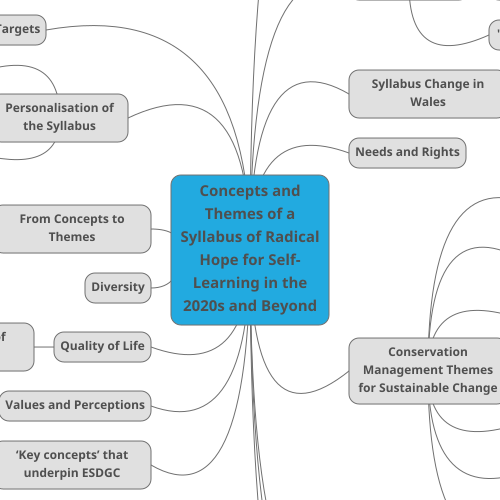
Regarding education for design thinking, it should be aimed at managing the hundreds of environmental issues, large and small, that are impeding the development of SIDS. In this context, mind mapping is the essential pedagogical process to produce a flexible interdisciplinary, personalized knowledge framework for learning about world development. This has been the goal of educational reform in Wales for half a century. There is a link from this post to a mind map that is being created by ICOL to consolidate and continue the Welsh work. The challenge for The Green Forum is to take a lead in defining holistic models of sustainability and human well-being. The objective is to support SIDS as they combat the effects of climate change and forge new pathways between schools and the communities they serve towards sustainable and inclusive development. ICOL is creating interlocking mind maps to guide deep thinking about islands as harbingers of an international syllabus of radical hope aimed at designing islands for survival.

Read More

https://www.mindmeister.com/2593970475/designing-islands-for-survival

Leptospirosis in the Seychelles : geographic, molecular
and epidemiological investigations of a zoonotic disease
in a tropical insular environment

Read More

https://theses.hal.science/tel-02952395/file/2020LARE0013LBiscornet.pdf

Artisan Circular Ecologies

Since 2009, the Ethical Fashion Initiative has provided vulnerable artisans with market access and training. It acts as a bridge, connecting marginalized artisan communities in challenging and remote locations with global lifestyle brands. Linking international brands with a network of SIDS-based artisans would give their communities access to the international marketplace. So the EFI creates an employment model for artisans and an opportunity to improve their lives. An artisan economy with meaningful work, and fair and decent working conditions, employing traditional skills, can foster the development of local design talent. In this context, SIDS offers a blank sheet to establish closed cycle manufacturing with community artisans that supports the development of export capacities in a global waste-free circular economy.

Read More

http://blog.culturalecology.info/2023/02/02/artisan-ecologies-2/
Denis Bellamy commented on Denis Bellamy's Post in Learning Circularity By Networking Cultural Islands

The Caribbean Community Climate Change Center (CCCCC) has long identified the greatest hazards of global climate change in the Caribbean as 1) sea-level rise, 2) hurricane events, and 3) precipitation variability (3). Human communities have experienced all of these impacts over time, necessitating a review of divergent human experiences based on the interplay between ways of life, ecological context, and environmental hazard. Archaeological and historical investigations demonstrate how human communities have lived through the impacts of climatic hazards over the past 6 ka.

Read More

https://www.pnas.org/doi/10.1073/pnas.1914211117

SIDS in 2014

In his grand sweep of 16th century Mediterranean history, French historian Braudel (1972: 154) had claimed that “the great problem” of the islands, never or only partly solved, was how to live off their own resources: soil, orchards, flocks, fish stocks; and “if that was not possible, to look outwards’ (ibid.). In spite of the mantra of sustainable development, islands fare best economically when they lure revenue from elsewhere, and the performance of their politicians often appraised by how well they manage to secure such largesse. Those small island territories that have, for some reason, been obliged to live off their own resources would have morphed themselves as plantation (and often largely monocrop) economies, providing non-essential goods to the kitchens of the West; but without the economies of scale of larger continental competitors, this business model has been shown to fail without those protectionist policies whose heyday is a thing of the past.

If this extra-territorial turn is the key to small island survival, then sovereignty may reduce its legitimate appeal and the chances of success of its resort. This then is a strong case for non-sovereignty: a political economy that secures autonomy but maintains the vital lifelines with larger, richer economies and their labour markets. And these links are especially significant in a post 9/11 context where the option to migrate is increasingly fraught by the regulations of the receiving countries, wary of heightened security concerns, stagnant economic growth and rising xenophobia. This approach may not sound like a ‘development’ strategy; but it has been, in its own right, a sustainable one. Today, vulnerability, resilience, dogged perseverance, and clever opportunism are best played out in a scenario where decolonization does not equal disengagement.

Godfrey Baldacchino

Read More

https://journals.openedition.org/etudescaribeennes/6984
Denis Bellamy commented on Denis Bellamy's Post in Learning Circularity By Networking Cultural Islands

The Gallatin School of Individualized Study provides a distinctive liberal arts education for a diverse student body. The faculty foster passionate intellectual commitments from learners and prepare them for a world in which managing knowledge is key to success.

Guided by the philosophy that self-directed learning is the key goal, the faculty seek to cultivate an environment conducive to intellectual exploration across traditional academic disciplines.

They insist on active student engagement in developing the direction of their own education. Its highly specialized and deeply engaged advisers guide students in their intellectual explorations toward an interdisciplinary approach to problem solving

Read More

https://gallatin.nyu.edu/about.html

Reliant on tourism and trade, Small Island Developing States (SIDS) were among the hardest hit globally by the economic impact of COVID-19.

Fiji and other SIDS could bounce back from the pandemic by building a sustainable blue economy that makes the most of their oceanic geography.

The Blue Recovery Hubs initiative, of which Fiji is a key participant, will examine SIDS to identify ocean-based and sustainable opportunities for growth.

Read More

https://www.weforum.org/agenda/2022/06/the-futures-small-island-developing-states-like-fiji-lie-in-t...

A mantra for the green economy: 'as the poor get richer the rich get poorer'.

Amol Rajan explores what switching to a green economy may mean for the way we live and work and whether it’s compatible with financial growth. If, for the sake of the planet we need to cut production, consumption and perhaps profit, then how will we pay for the essential services we need in the future? There are some difficult choices to make that sound particularly tough amid a cost-of-living crisis. However, despite all the difficulties, there are those who foresee a cleaner, fairer and more enriching world.

Graihagh Jackson, presenter of the BBC podcast ‘The Climate Question’ is with Amol Rajan alongside guests Professor Tim Jackson, Bernice Lee, Najma Mohamed and Dr Rhian-Mari Thomas.

The full episode is available via the BBC website. If you have difficulties accessing the episode from outside the UK, please try Apple podcasts.

Podcasts→
Further reading
Let’s Be Less Productive—Restoring the Value of Care | Article by Tim Jackson for The New York Times
MARCH 26, 2020
Let’s Be Less Productive—Restoring the Value of Care | Article by Tim Jackson for The New York Times
Wellbeing Matters—Tackling growth dependency | Policy Briefing
FEBRUARY 28, 2020
Wellbeing Matters—Tackling growth dependency | Policy Briefing
The Post-Growth Challenge — Secular Stagnation, Inequality and the Limits to Growth | Working Paper by Tim Jackson
MAY 13, 2018
The Post-Growth Challenge — Secular Stagnation, Inequality and the Limits to Growth | Working Paper by Tim Jackson
Animation | Mental health in the context of growth-dependency and climate breakdown—Short-film animation
OCTOBER 9, 2022
Animation | Mental health in the context of growth-dependency and climate breakdown—Short-film animation
Why health should replace wealth as the heart of prosperity | Blog by Tim Jackson and Julian Sheather
NOVEMBER 5, 2021
Why health should replace wealth as the heart of prosperity | Blog by Tim Jackson and Julian Sheather
Paradise Lost?—Existential anxiety and the iron cage of consumerism | Blog by Tim Jackson
DECEMBER 23, 2018
Paradise Lost?—Existential anxiety and the iron cage of consumerism | Blog by Tim Jackson

Read More

https://cusp.ac.uk/themes/aetw/tj-bbcradio4-rethink/

Small Island States: educational models of cultural ecology

https://en.wikipedia.org/wiki/Cultural_ecology

Small Island Developing States are in actual fact vast oceanic States. The future of the planet depends, to a large extent, on their future. They are at the forefront in demonstrating the power of culture to forge responses for resilience and adaptation to extreme hazards and climate-induced disasters. Spanning from the Caribbean to the Pacific via other islands in the Atlantic Ocean, Indian Ocean and South China Sea, the SIDS are a mosaic of diversity. Differing in terms of population size and densities, geographical spread and present differentiated development patterns. 30% of the world's ocean natural and cultural resources are under their custodianship and the safeguarding of these resources are becoming increasingly challenging as a result of multiple combined factors.

Read More

https://www.unesco.org/en/articles/cutting-edge-small-island-developing-statescultural-diversity-dri...